Travel Documentation
Proof of Onward Travel for Japan: The Official Rules
- Author
 Reed Ashworth
- Published
- Updated
- Read time
- 9 min

Japan doesn't require a pre-paid return ticket, but you should have proof of onward travel. Here's what MOFA and the State Department actually require.
If you're flying into Japan on a visa-exempt passport, you don't need to already own a fully paid return flight home. What you do need is proof of a return or onward ticket, something you can produce if the airline or a border officer asks for it. That's the actual rule, not the version that circulates on travel forums.
The U.S. Department of State's Japan page tells visa-free visitors plainly: carry a valid passport and have proof of a return or onward ticket, with the passport remaining valid for the whole stay. You don't need your return date locked to the exact day. What's required is a booking that names you and your flight, with a date you can show if it comes up.
We wrote this because the searches that bring people here keep repeating the same word: official. Queries like "japan immigration temporary visitor proof of onward ticket sufficient funds official" show up again and again, and most of what ranks for them is a forum thread or a blog's best guess. So this guide sticks to what the Ministry of Foreign Affairs, the Immigration Services Agency, and the State Department actually publish, alongside what we've learned running an onward-ticket service that Japan-bound travelers use for exactly this situation.
What the official rules actually say
Two government sources cover this. Read together, they answer most of the question.
The Ministry of Foreign Affairs of Japan's page on visa exemption sets out who can enter without a visa and for how long. It doesn't spell out a document checklist for onward tickets, that detail lives in immigration procedure and airline obligation, covered further down, but it's the page that determines everything else: whether you need a visa at all.
The U.S. State Department's Japan entry page is more direct. Visa-exempt travelers "should have proof of a return or onward ticket." Not "must present at every arrival." Should have. That word choice matters: it means the document needs to exist and be producible, not that every arriving passenger gets asked for it at the border.
Temporary Visitor status: who it covers and for how long
Visa-exempt entry places you in Japan's Temporary Visitor category. Japan has visa exemption arrangements with 74 countries and regions, and for most of them the stay granted on landing is 90 days.
| Nationality group | Typical stay granted on landing |
|---|---|
| Most visa-exempt nationalities | 90 days |
| Indonesia, Thailand | 15 days |
| Brunei, Qatar | 30 days |
Per the Consulate-General of Japan in Detroit, Temporary Visitor status covers sightseeing, business meetings, conferences, unpaid educational programs, and visiting friends or family. It doesn't allow paid work, and that restriction is really why immigration cares about your travel plans at all. They're weighing whether your stated purpose, a short visit, matches your documents: a ticket that actually leaves again within the permitted window.
Sufficient funds and accommodation: no fixed number, but be ready
Neither the MOFA visa-exemption page nor the State Department's Japan page publishes a minimum amount you need in your account. If you've read a specific figure somewhere, it isn't an official one. What the State Department does say is that officers can deny entry to a visitor who can't show how they'll support themselves during the stay. That's a judgment call made at the counter, not a line item on a form.
In our experience helping people prepare for this, the practical answer is to have something concrete to point to: a hotel booking, a rough itinerary, a bank balance visible on your phone, and proof you're actually leaving. An open-ended one-way ticket with no accommodation and no visible funds is the profile that draws follow-up questions. A round-trip or onward booking paired with a first-night hotel reservation answers most of it before anyone has to ask.
Where you'll actually be asked: check-in, not the border
This is the part most guides skip. Japan's Immigration Control and Refugee Recognition Act puts the document-checking duty on the airline, not the border officer. Article 56-2 requires the carrier operating your flight to check passports and related documents before departure, and Article 59 makes the airline responsible for flying a refused passenger back at its own expense. That's why an unclear onward-ticket situation usually surfaces at the check-in counter in your departure city, hours before you ever reach Japan, rather than at Japanese immigration itself.
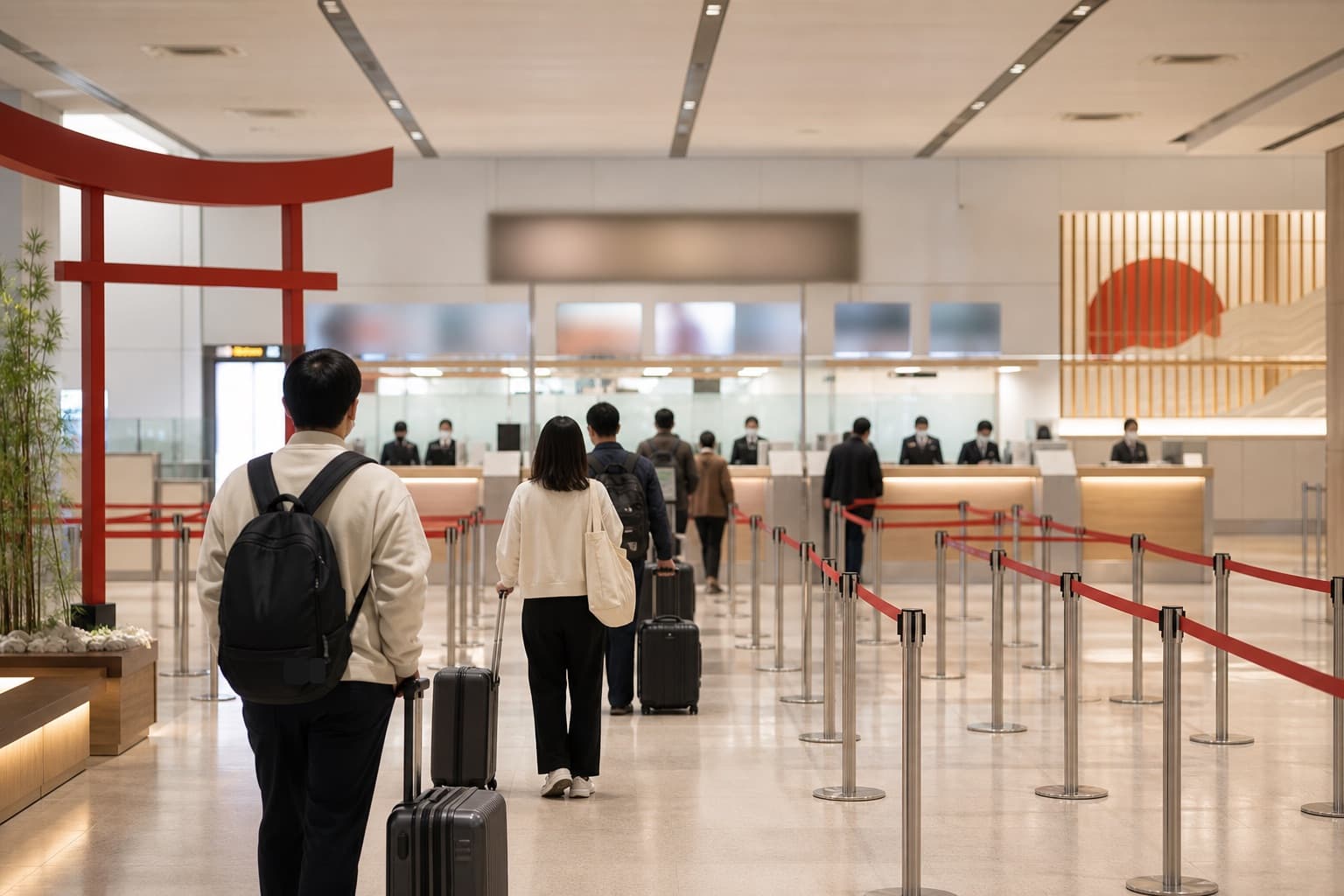
At the landing inspection itself, officers from the Immigration Services Agency check your passport and, from nearly all foreign visitors (children under 16 and a small number of other categories are exempt), collect a fingerprint scan and a photo. Refusing that biometric step means you won't be let in. Many travelers now handle the paperwork side in advance through Visit Japan Web, the government's official pre-registration service, which turns your immigration and customs declarations into a QR code shown on arrival. The airline check-in desk, not that biometric step, is where an onward-ticket question is more likely to come up, and it's the one fewer travelers plan for.
If you don't have a return flight booked yet
Plenty of people land on this page because their return date isn't set. Maybe the trip is open-ended, maybe you're continuing to another country and haven't booked that leg yet. Either way, what an airline or immigration officer wants to see is a real onward booking, not necessarily one you're committed to actually flying.
We run DummyTicket24, an onward-ticket service, and this is the exact situation it exists for. A reservation from us is a real airline booking with its own PNR (booking reference), not an edited PDF, and it can be looked up on the airline's own website or a booking-lookup tool like CheckMyTrip the same way any other reservation can. We've been issuing verifiable onward-ticket reservations since August 2024, and Japan is a regular destination among them. It costs $14 and arrives by email in about 60 seconds. It stays live and checkable for 48 hours from the time you order, enough to cover a same-day airline check-in or a next-day embassy visit with room to spare.
One wrinkle worth knowing before you get to the check-in desk: some airlines show their own internal record locator on the Manage Booking page instead of the reference printed at the top of your confirmation email. Turkish Airlines is a common example of this. If a lookup fails, try the airline's own record locator from the confirmation rather than assuming the booking doesn't exist. Our travelers are mostly heading out of the United States, the United Kingdom, the UAE, Australia, Thailand, Indonesia, Canada, the Philippines, and Germany, so a lookup question like this one comes up routinely, not as a one-off edge case.
If you'd rather have this handled than dig through airline booking systems yourself, our onward ticket for Japan page walks through it, and the broader version of this same approach is covered in our guide to onward tickets for visa applications.
Visa-required nationals: a stricter, paper-heavy process
If your passport doesn't get visa-free entry, the onward-ticket question turns into a bigger document requirement altogether. The Consulate-General of Japan in Houston lists, for a Short-Term Stay tourist visa, a complete round-trip flight itinerary or reservation and a day-by-day Schedule of Stay naming the hotels you'll use, with addresses and phone numbers, alongside the passport, application form, photo, and financial proof. That's a materially different bar than "should have proof of a return or onward ticket." Visa-exempt travelers can often book close to departure; visa applicants need the whole itinerary settled before they submit the application.
Where DummyTicket24 fits
We're not a travel agency and we don't pretend to be one. DummyTicket24 exists for one narrow job: producing a real, checkable onward reservation for people who need to show one and don't yet have their travel fully locked down. Whether an airline agent in Bangkok or an immigration officer in Narita actually looks at it is genuinely up to them, that decision always sits with the person checking documents, never with us. What we control is whether the document itself is real and verifiable, and that's the part we take seriously.
FAQ
Do I need a hotel booking as well as a ticket to enter Japan?
There's no single document that covers everything, but a hotel reservation is one of the clearest ways to answer the sufficient-funds question. Neither MOFA nor the State Department publishes a required list. Having a booked place to stay and an itinerary, plus proof you're leaving again, covers the same ground an officer is actually assessing: can you support yourself, and is your visit temporary.
Can I enter Japan on a one-way ticket?
Nothing in Japan's official rules bans one-way entry outright, but it removes the easiest evidence that you're a Temporary Visitor rather than someone planning to overstay. Since the checking duty sits with the airline under Article 56-2, a one-way ticket is more likely to draw questions at your departure check-in counter than at Japanese immigration itself.
Does Japanese immigration check onward tickets at the airport, or is it the airline?
Mostly the airline, and mostly before you even board. Article 56-2 of Japan's Immigration Control and Refugee Recognition Act puts the passport and document check on the carrier, and Article 59 makes the airline responsible for flying back a passenger who's refused landing. At the landing inspection itself, Immigration Services Agency officers focus on your passport, fingerprints, and a photo (children under 16 are exempt from biometrics), and can ask about your onward travel, but the first checkpoint is almost always the check-in desk.
What's different if I need a visa instead of entering visa-free?
A lot more paperwork. Consulates such as the one in Houston ask Short-Term Stay tourist visa applicants for a full round-trip flight itinerary or reservation and a day-by-day Schedule of Stay naming the hotels, addresses, and phone numbers for the whole trip, on top of the passport, application, photo, and funds proof. Visa-exempt travelers get far more flexibility on timing than visa applicants do.
What counts as an acceptable onward ticket if I haven't decided my return date?
A real reservation with its own PNR that you can look up on the airline's website, not an edited PDF. A DummyTicket24 booking works this way: it's $14, arrives by email in about 60 seconds, and stays live and checkable for 48 hours from the order, long enough to cover an airline check-in or an embassy visit.
Keep reading
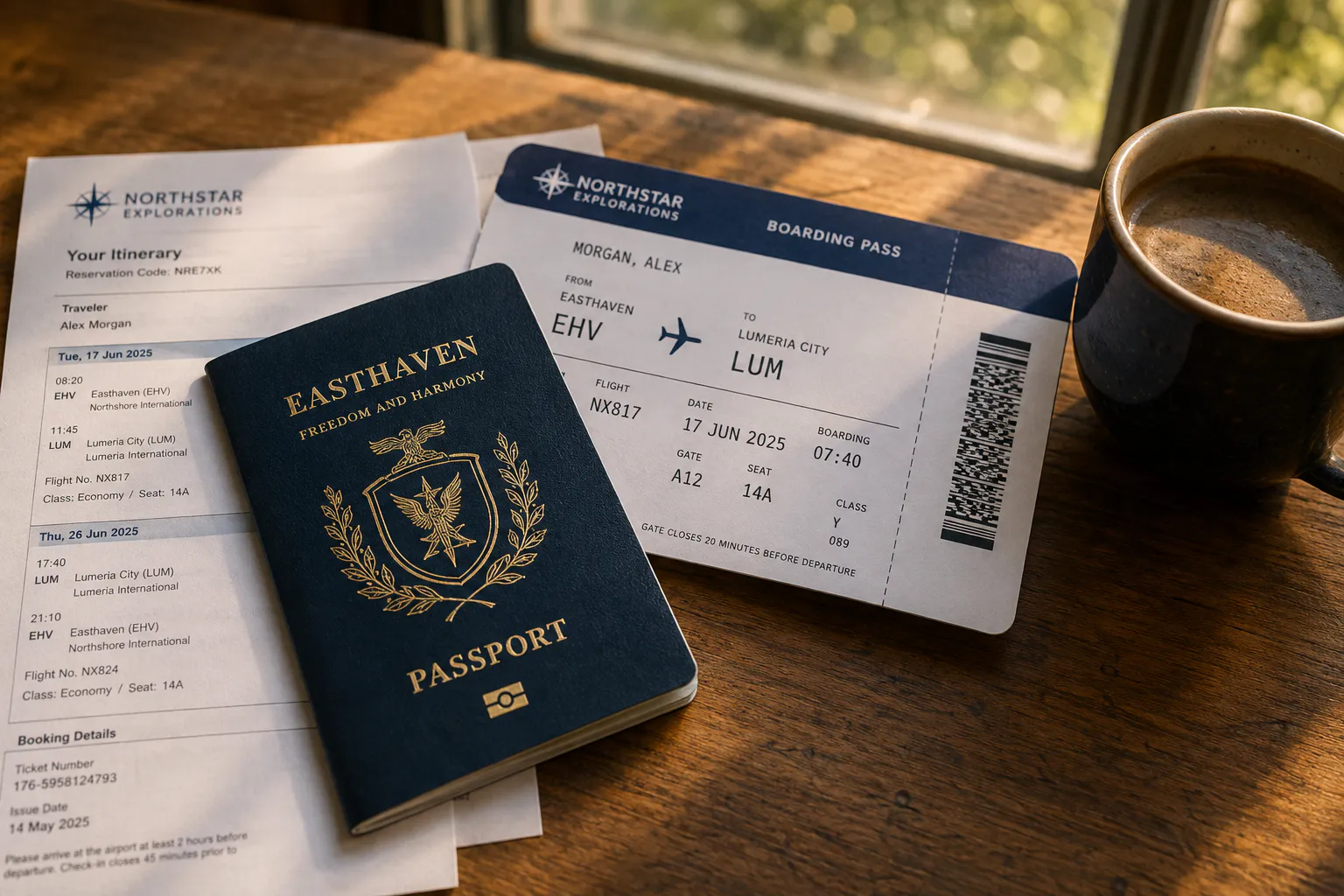 Flight Reservation vs Flight Ticket for VisaA Schengen flight reservation is a verifiable PNR-based booking used as proof of travel, not a paid ticket, and it never guarantees visa approval.22 min read
 Do Embassies Verify Dummy Tickets? What Really HappensYes, embassies and visa centers can verify a dummy ticket's PNR in airline systems, so submit a genuine, verifiable reservation that matches your visa file.17 min read
 Are Dummy Tickets Safe & Legal? 2026 Visa GuideLearn what a dummy ticket is, whether it is safe and legal for a visa, how embassies verify a real PNR, and how to avoid fake itineraries before you book.9 min read